
Cartothèque
A complete online store, from catalogue to checkout.
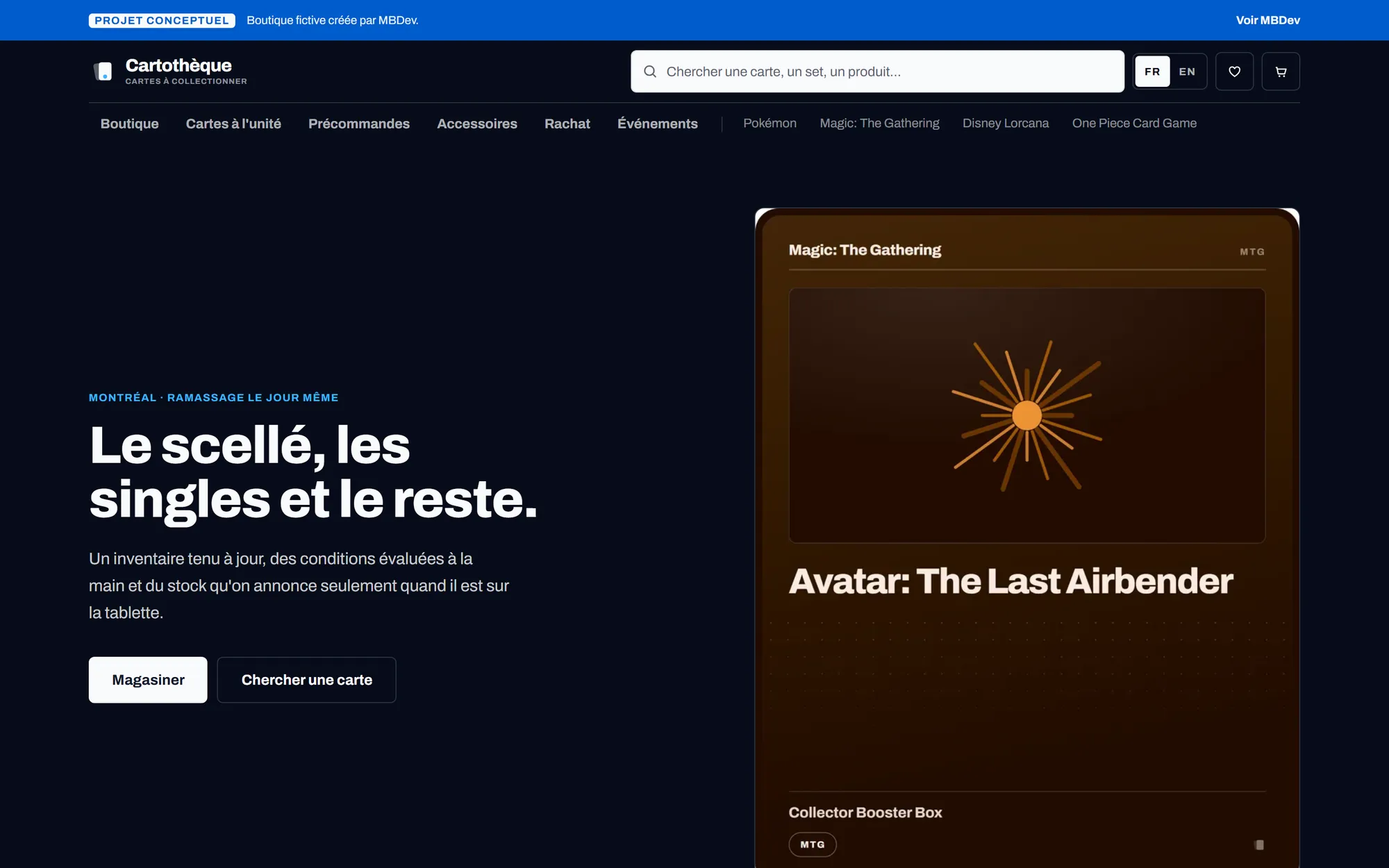
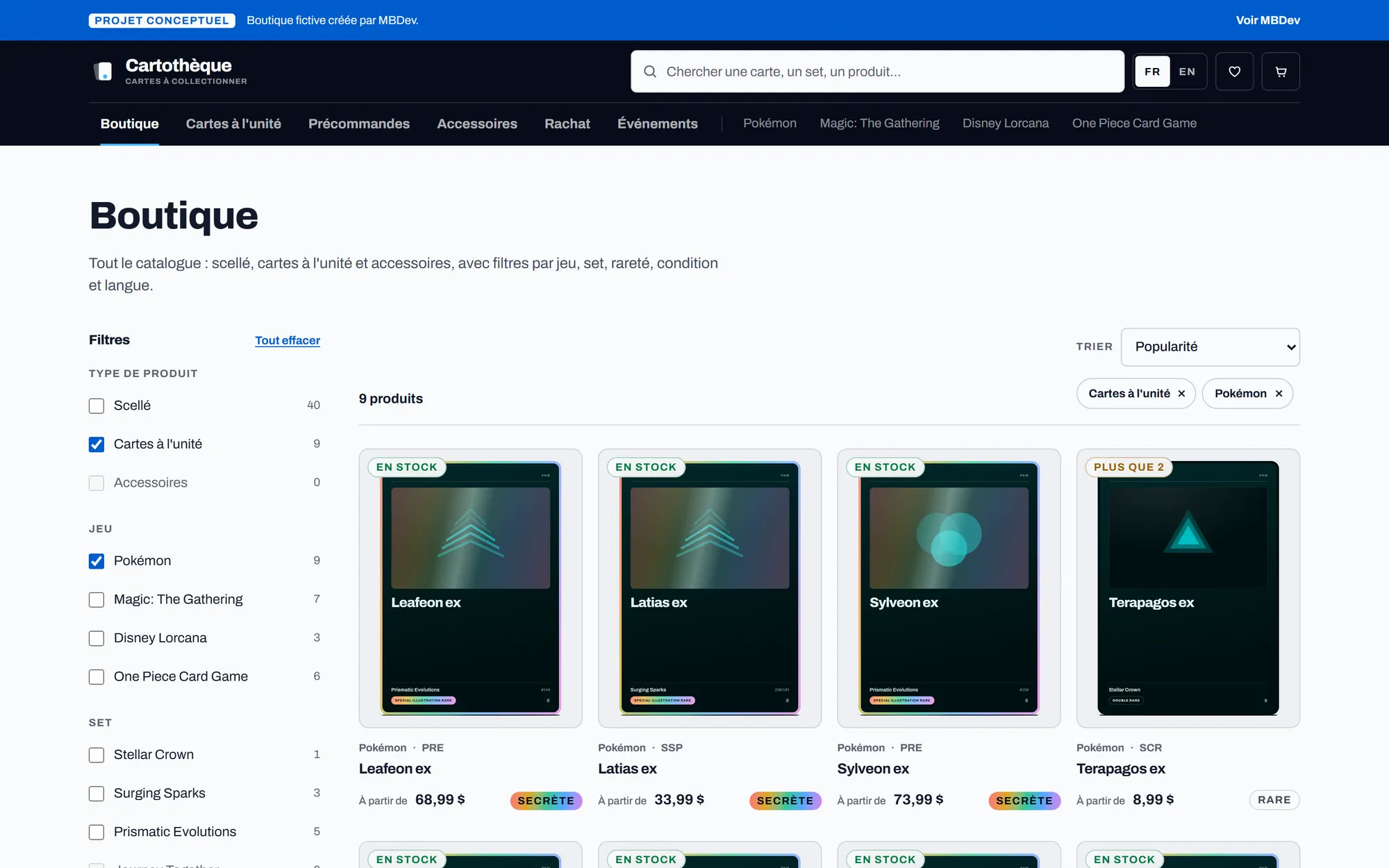
A concept project: a trading card store. A catalogue of nearly 200 products, instant search, combinable filters, a persistent cart, promo codes, a four-step checkout, preorders and collection buybacks.
The question this demonstration answers
“Have you ever built an online store?” A marketing site doesn't answer that question, and a store theme installed in an evening doesn't either: it proves you can pick a template, not that you can build commerce.
Cartothèque is a store built from scratch. The behaviour is real — search really searches, filters filter on the server, the cart survives a reload, and tax calculation follows the exact order a Quebec business needs. It's the commercial data that is fictional, and it says so.
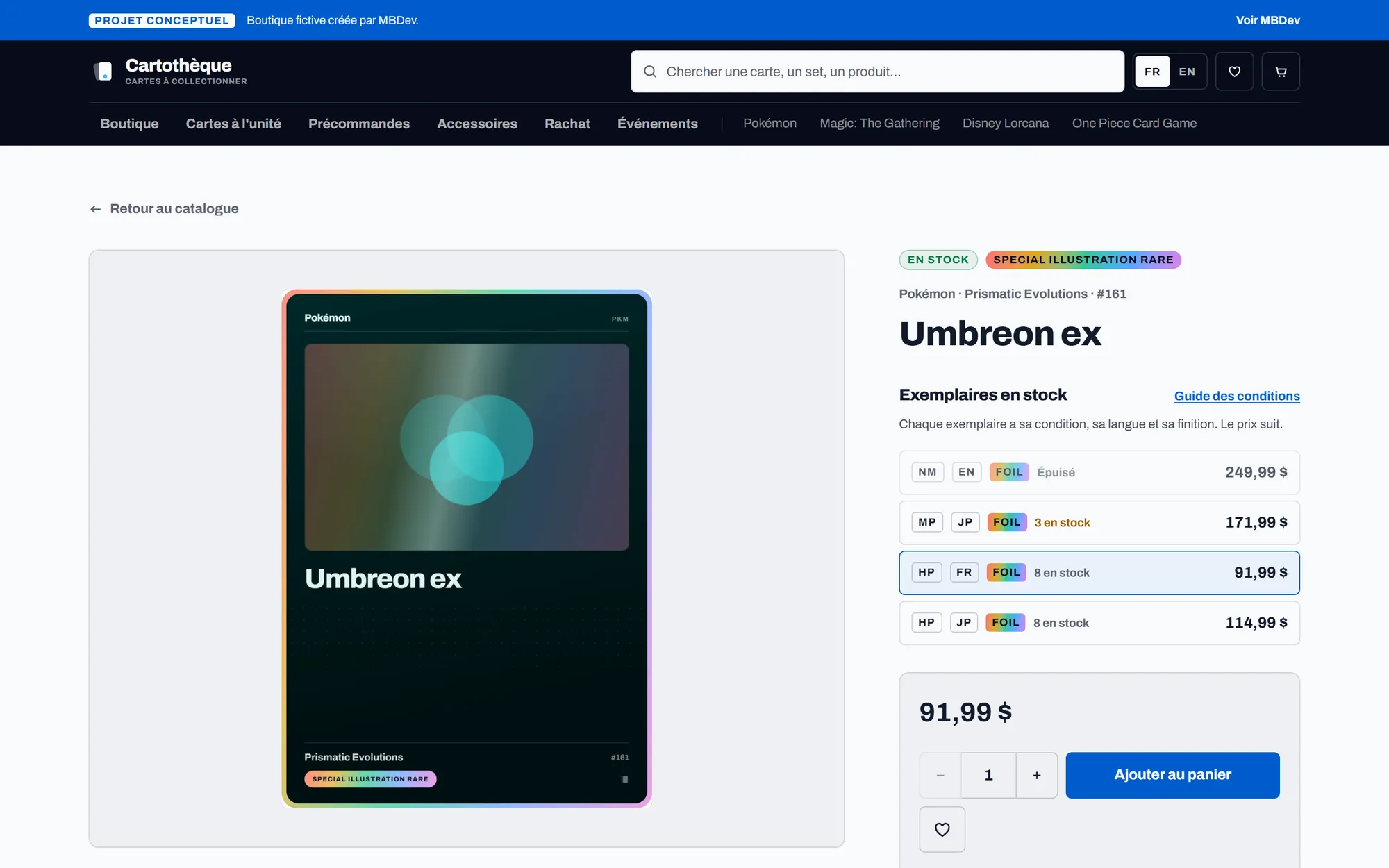
Card retail was chosen because it is one of the most demanding cases in e-commerce: the same product exists in several conditions, several languages and several finishes, each with its own stock and its own price. A catalogue that handles that also handles a clothing store or a parts supplier.
What that means for a business
A customer who can't find a product doesn't buy it. Search answers as you type, tolerates accents and works from the keyboard; filters combine, show a result count per criterion and live in the URL — a link to filtered results can be shared as is and reloads identically.
The buying journey goes all the way: a persistent cart, promo codes that genuinely calculate with their minimum, shipping, free shipping judged after the discount, GST and QST kept separate, and a four-step checkout with validation and focus handling. No transaction is processed, and every screen says so before and after the click.
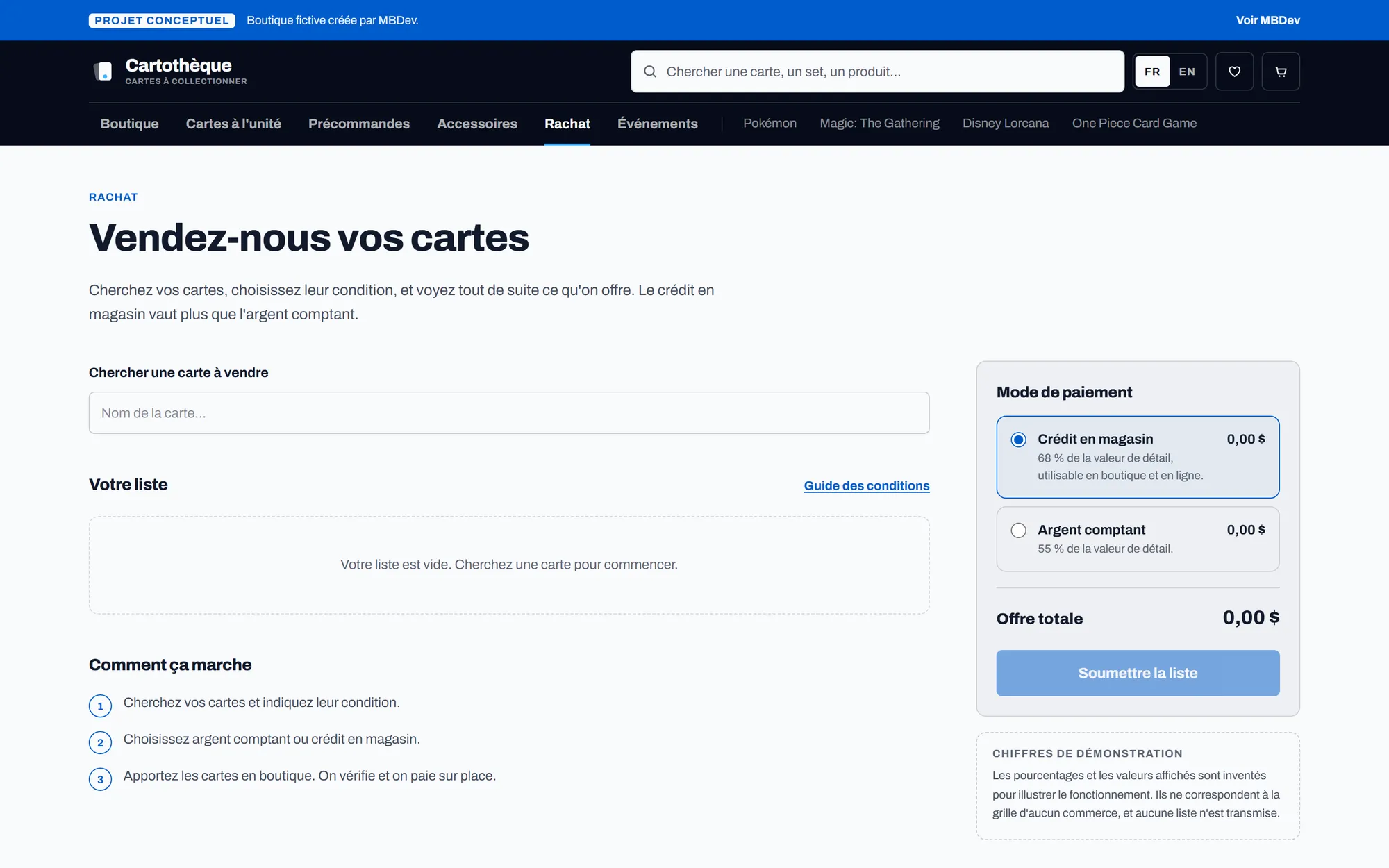
Two less common journeys round out the demonstration: preorders, with a release date and billing on shipment, and collection buybacks, which value a lot by card condition and offer cash or store credit. These are exactly the edge cases a template doesn't cover.
Real names, and no official imagery
The store names real games, real sets and real cards: a catalogue of imaginary universes would read like a template filled with sample text. Naming the products you sell is what every card shop does.
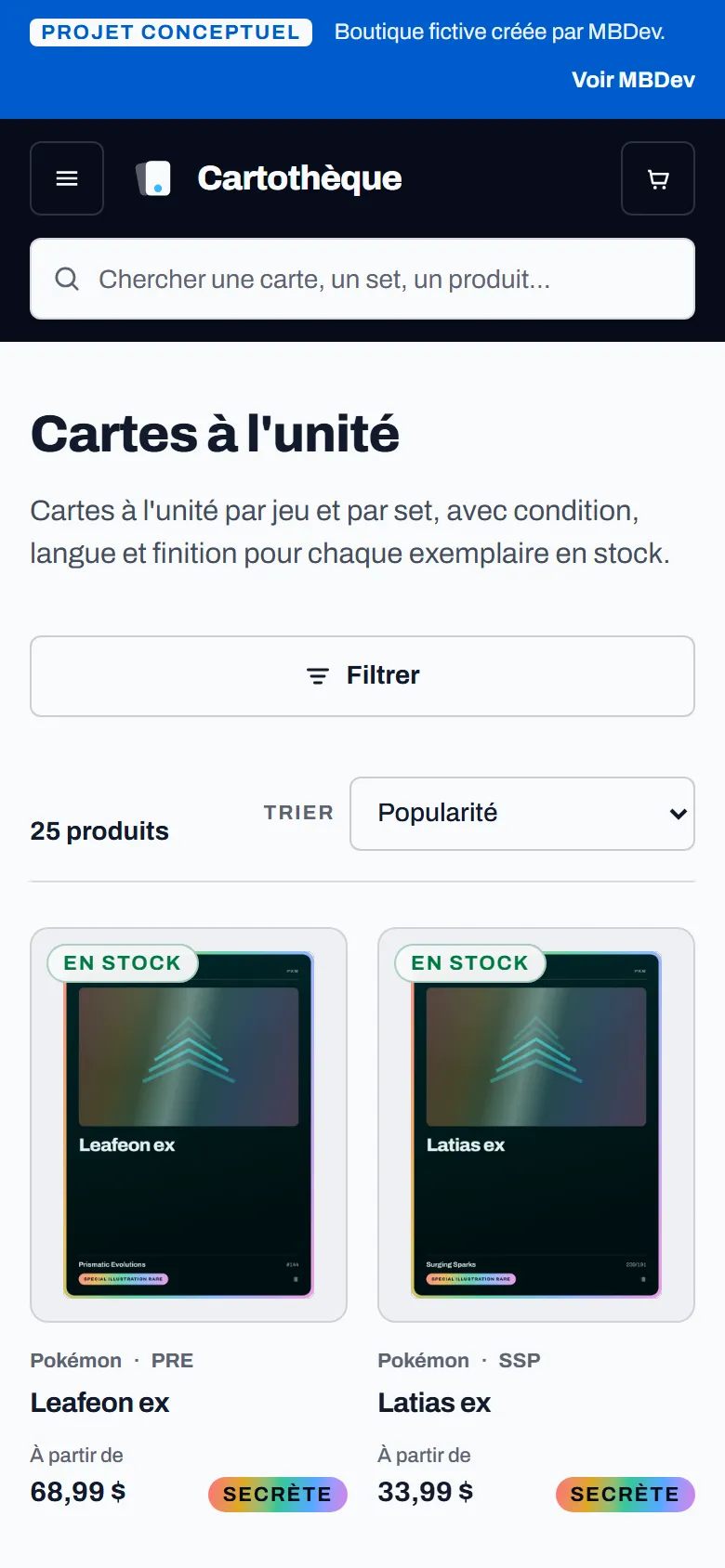
No official imagery is used, though — no artwork, no card scans, no product photography, no images taken from another retailer. I hold no permission to republish those visuals in portfolio work. The product boards were drawn for Cartothèque instead, and the site explains that itself.
This isn't a technical limitation: wiring a catalogue up to client-supplied photography is routine work, and it is what a real engagement would call for. It is a decision not to reproduce visuals I do not hold the rights to. Same rule for the data: a name, a number or a date that couldn't be verified is omitted rather than approximated.
Screenshots
What's inside
- A 197-product catalogue — sealed product, singles and supplies — across 45 sets
- Instant search, accent-tolerant, fully keyboard navigable
- Combinable filters reflected in the URL, with server-side filtering
- Cards sold by copy: condition, language, finish, stock and price for each
- Persistent cart, promo codes, GST and QST kept separate, four-step checkout
- Dated preorders and a collection buyback tool
- Bilingual, keyboard accessible, no overflow down to 320 px
- No official imagery: all 197 product boards are drawn for the demonstration