
Live Lab
Operations software that genuinely runs, in your tab.
A concept project: a distributor's internal software. Orders, inventory, customers, automations, reporting and an audit log — all wired together, with a thirty-day simulation that runs the business in front of you. Everything executes in the browser, with no account and no server.
The question this demonstration answers
“Could you build our internal tool?” A dashboard doesn't answer that. There are thousands of them: cards, charts, numbers that never move. They prove you can draw a screen, not that you can hold data together.
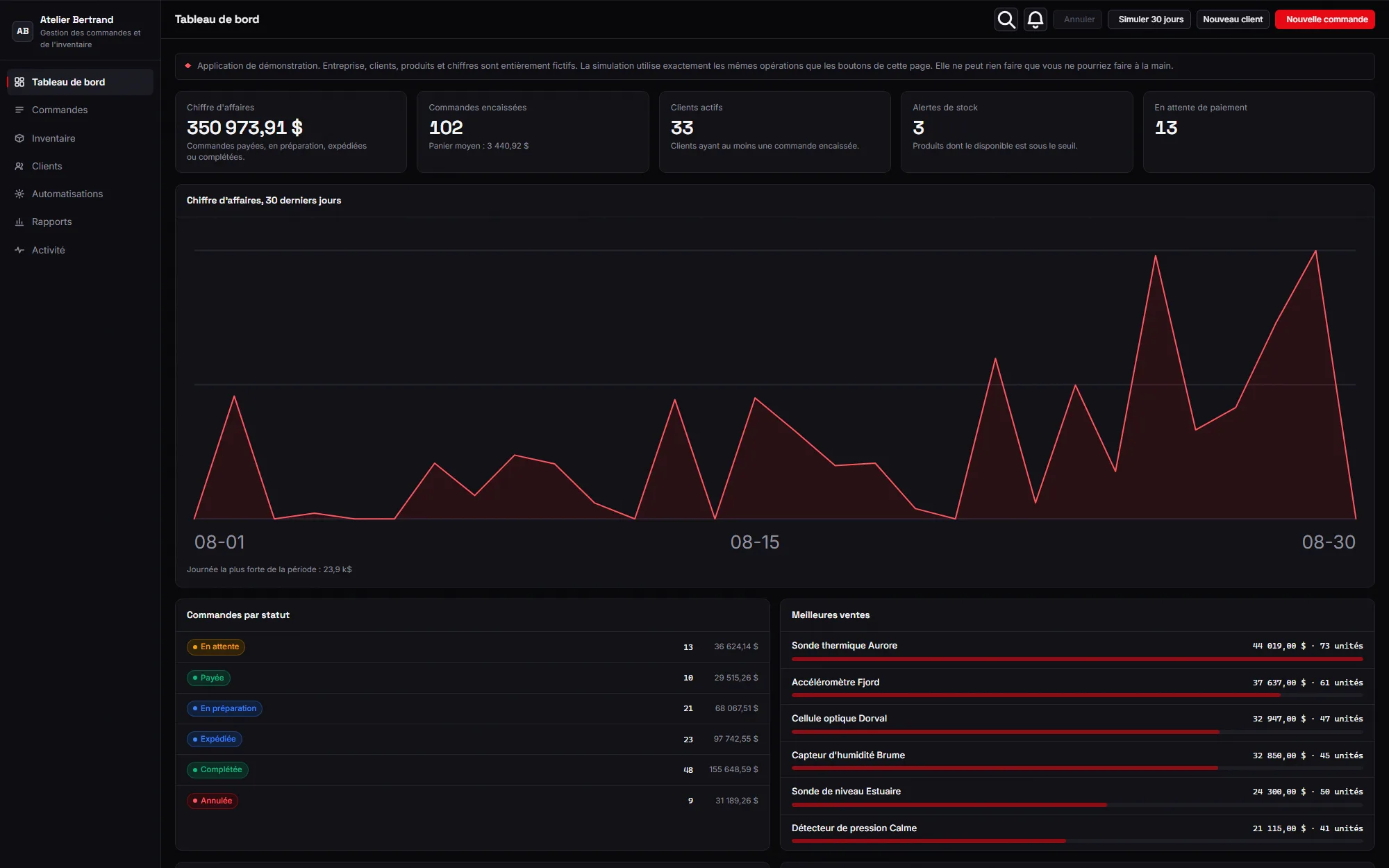
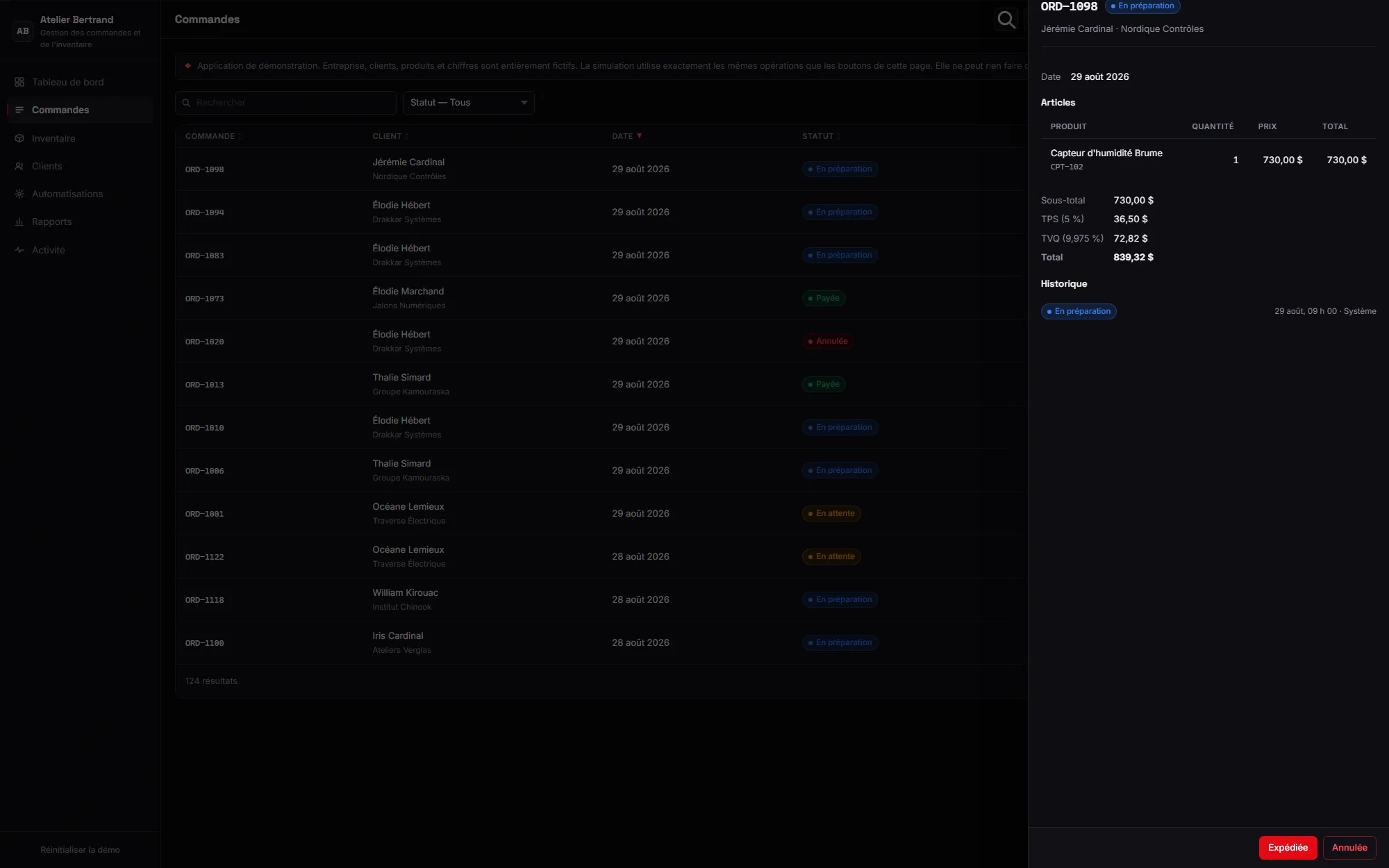
Live Lab is a complete management application, and everything in it is wired. Create an order: it appears in the list, the product's stock is reserved, the customer's lifetime value rises, the audit log records it, an automation rule evaluates it, and the dashboard's revenue changes by the exact amount. Undo, and everything returns to the cent.
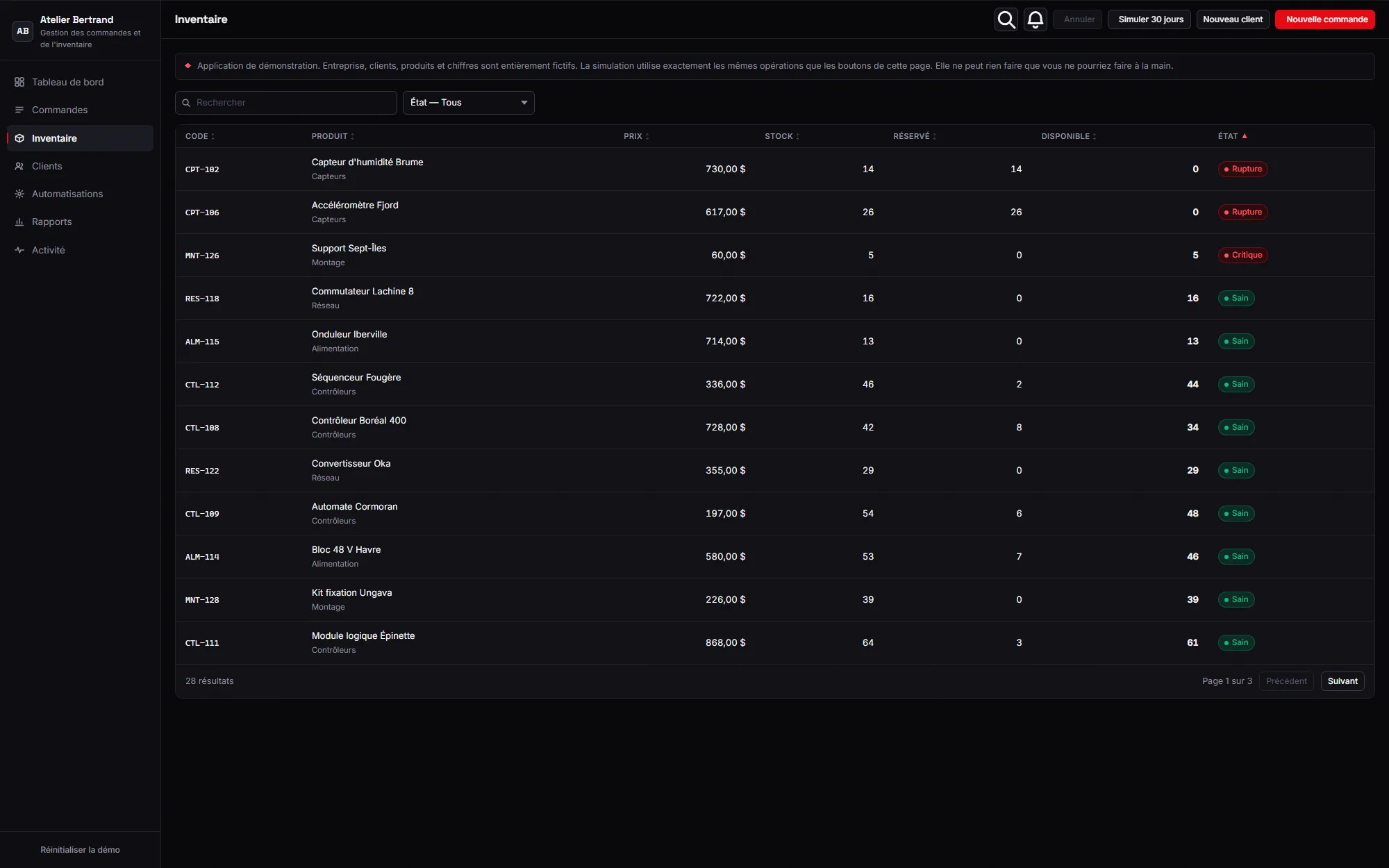
An equipment distributor was chosen because it is the case where the links are tightest: the same product has physical stock, a quantity already promised, and a quantity actually sellable. Confusing the three means overselling. A system that holds that distinction also holds a workshop, a clinic or a rental service.
Thirty days in seven seconds
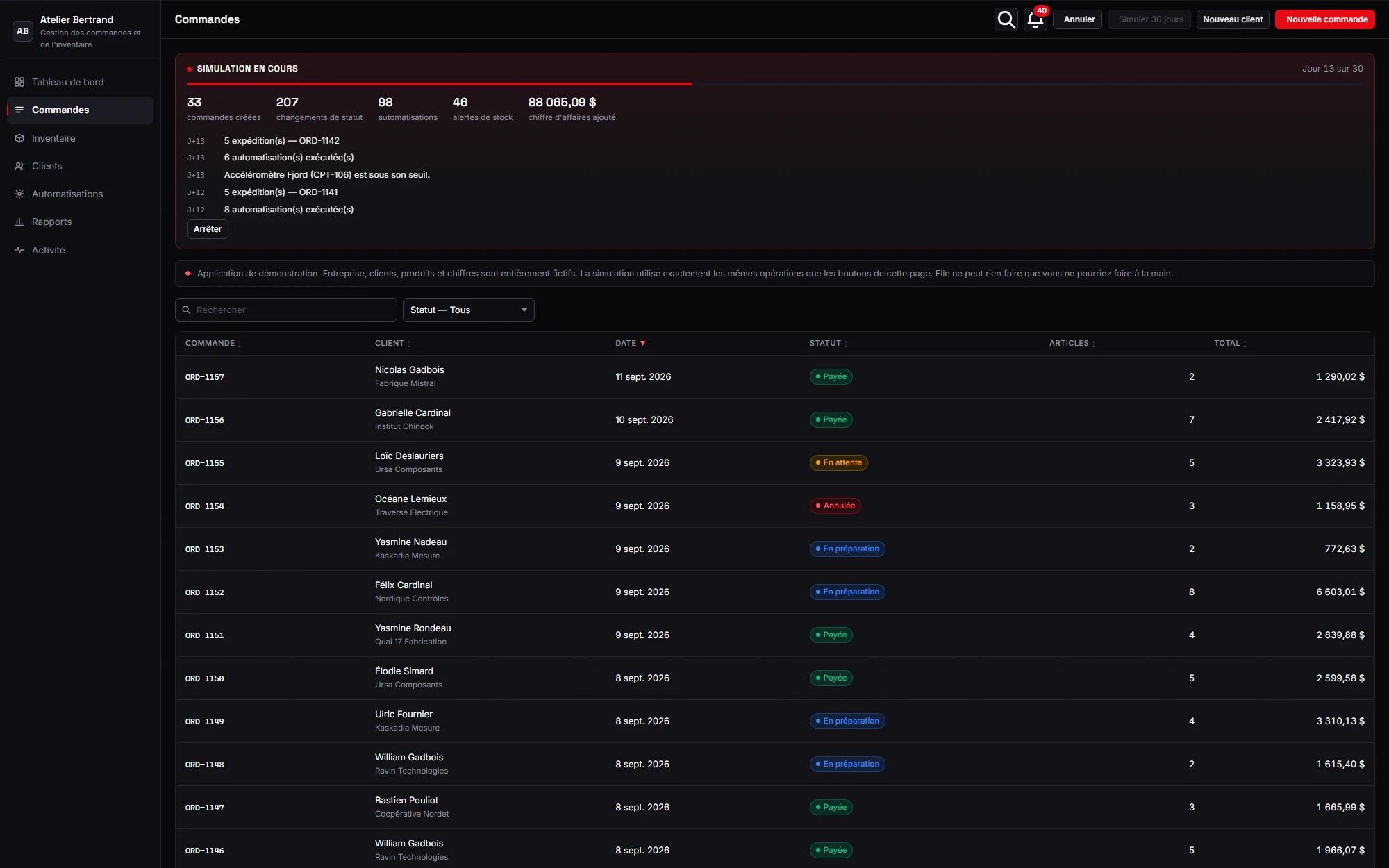
The “Simulate 30 days” button runs the business in front of you, one day at a time: orders appear, advance, ship, and a few get cancelled. Stock falls, alerts fire, automations run, revenue climbs.
What matters is what the simulation is NOT allowed to do. It doesn't write to the data: it calls exactly the same operations as the on-screen buttons. If it tries to ship an order with no stock, it is refused just as a click would be — and the refusal is counted and displayed, not hidden. A test verifies that stepping day by day produces exactly the same result as computing it in one pass.
The thirty days then undo in a single action. That is the demonstration in one sentence: what you see moving isn't an animation, it's the system's real state.
Derived numbers, and a checker that refuses incoherence
No indicator is stored. There is no “revenue” field and no “lifetime value” field anywhere: everything is recomputed from orders and products at render time. That makes the most embarrassing failure of business software impossible — two screens announcing two different totals, with no way to say which one is wrong.
The system carries its own written rules: stock never goes below zero, reserved never exceeds stock, the reserved quantity matches exactly the paid-but-unshipped orders, and the dashboard's revenue equals the sum of booked orders. These are checked after every test scenario, including after a full simulation — and five tests prove the checker genuinely detects corrupted data injected into it.
The application is bilingual, fully keyboard operable, respects reduced motion, and its persistence lives in your browser: nothing is sent anywhere. The reset button really erases.
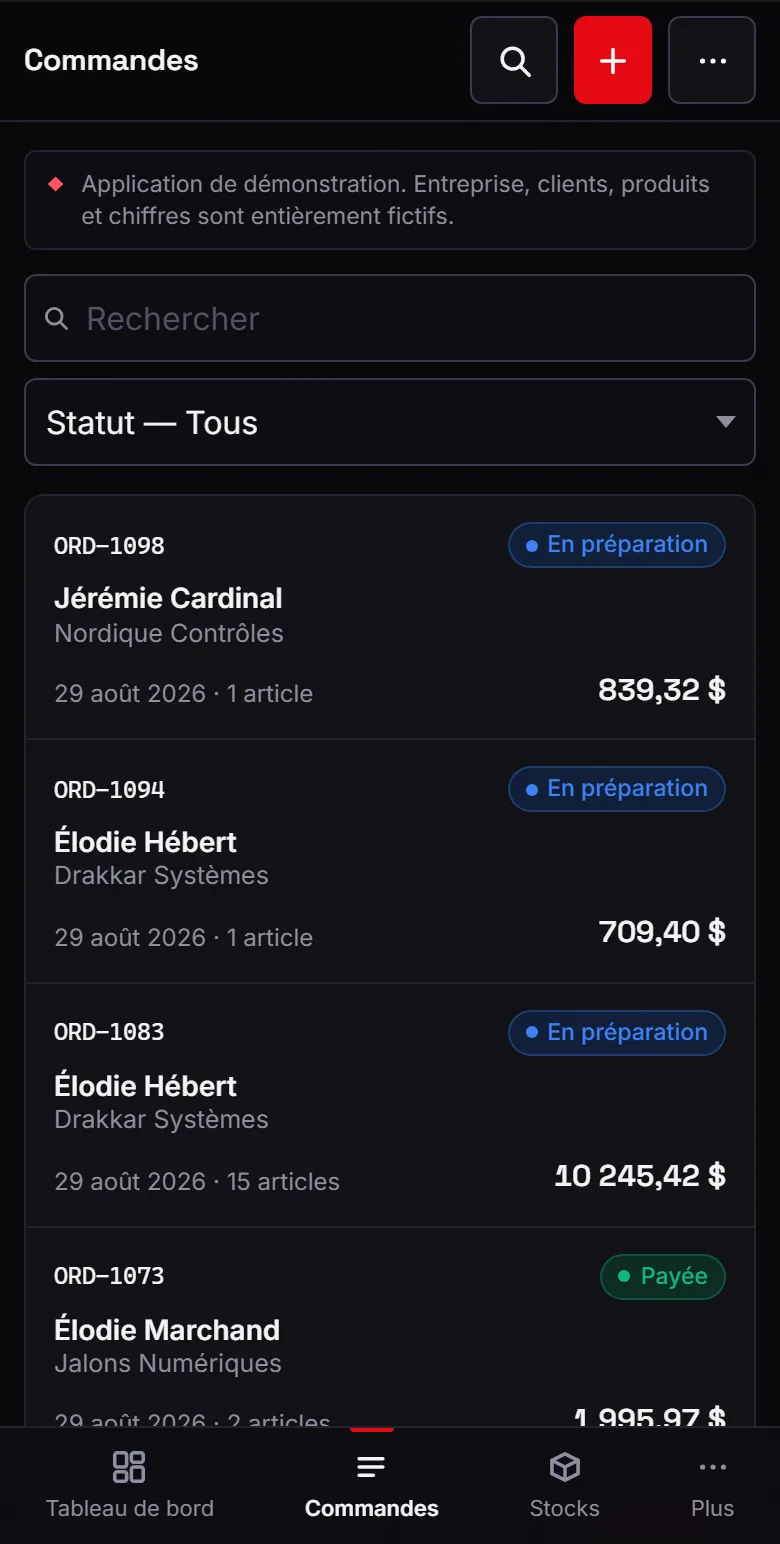
Screenshots
What's inside
- Seven wired modules: dashboard, orders, inventory, customers, automations, reporting and an audit log
- Stock, reserved and available held separately, with a controlled order state machine
- No stored indicators: every number is recomputed from the data
- A thirty-day simulation calling the same operations as the interface, refusals included
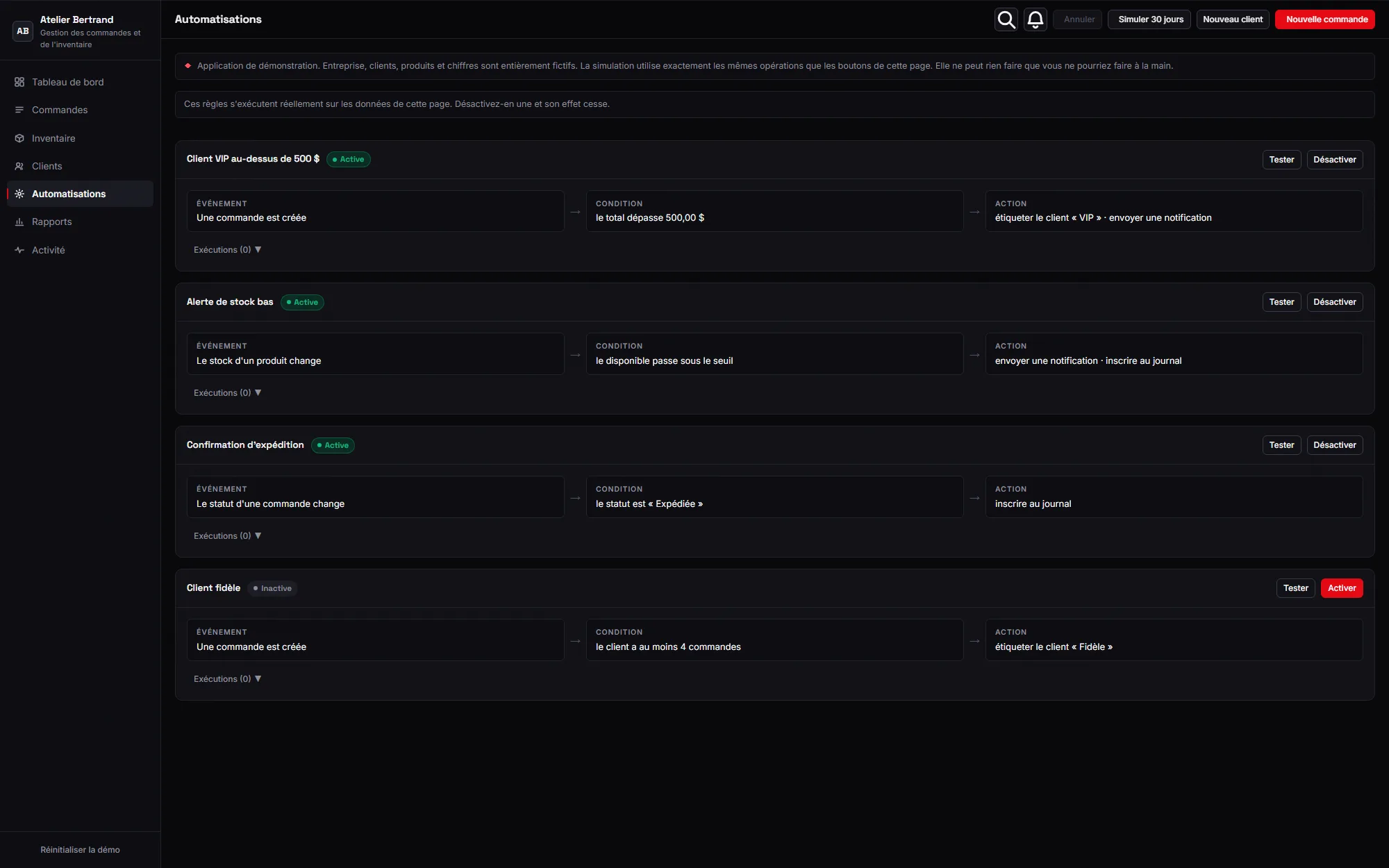
- Automation rules that genuinely execute, including a trace of their negative evaluations
- Undo that restores the full state, an entire simulation included
- Instant search, filters, sorting, CSV export and a keyboard command palette
- On a phone: cards rather than tables, bottom navigation, no overflow down to 320 px
- Bilingual, browser-local persistence, no data sent anywhere